I have kept a sketchbook/journal, since I was in High School. Over the years, the format of these books has evolved. Here is a record of that evolution.
Large bound sketchbook
 |
Hard-bound 8.5" x 11" sketchbook with fancy cover
|
 |
Typical spread in a large , college journal
|
My first regular sketch journal was a large, 8.5" x 11", hardcover-bound book. Rather than just the drawings that would fill my regular sketchbooks, I would fill the journal with my written ideas, notes, scribbles, poems, musings, clippings, photos, rough sketches, and color studies.
I kept one handy all through high school and college.
They were largely private, never shared with strangers, rarely shared with anyone else, even friends, except in small, select peeks. This was because the contents were often, raw, unfiltered, autobiographical. That was the point, a kind of incubator for ideas, not a display for public consumption and judgement. However, being large, and visible, and possibly because they were restricted, they were always objects of intense curiosity and interest.
For that reason, after college, I switched to a smaller, pocket-sized, format.
Fat Lil' Pocket Notebooks.
 |
| Fat Lil' Pocket Notebooks were delightfully chunky | | | | | | | |
| | |
|
|
|
|
|
I first gravitated towards Mead, 5-star brand, Fat, Lil', Pocket Notebooks I found at the local Five & Dime. They were cheap, spiral bound, and at about 3.5" x 5.5", 200 pages, almost square, with a nice heft. A lot of friends asked me why don;t you just buy a Moleskin sketchbook and use that? Moleskins were not exactly cheap, and always felt a little pretentious, like they were made to be the "official" artists sketchbook. I wanted something that felt more like me, and would not inhibit me, by making me worry about how expensive the paper was, or creating a sense of expectations. Like even your ideas had to be good enough to be worthy of a Moleskin. The Lil' Pocket notebooks were delightfully common and low-grade, containing pulpy, ruled paper. You could put the stupidest, most outlandish ideas on that paper, and not feel guilty at all. I drew in ballpoint or Micron ink pen. If I was going to draw something more elaborately, I would sometimes draw on yellow sticky notes and then paste them into the pages of the notebook.
I would fill them fairly rapidly, about one every two months or so.
Over time, it turned out that the paper, really was a little too crappy, and started to yellow after only a few years, so I started looking for something just a bit better in quality.
Carolina Pad
 |
Carolina Pads, cheap, lined paper
|
One day I was visiting Bob Slate Stationers, in Cambridge, MA, and I found a little, leather-bound memo pad holder that took a standard Carolina Pad, 2.5" x 4" 50-sheet pads. That was the standard for years. But I grew tired of working on lined paper, and the unlined paper was usually of an inferior grade, plus the nice leather holder completely disintegrated...so back to the drawing board. (so to speak).
Caliber Scratch Pad
 |
A one quarter pad, roughly 4" x 2.75" 100 pages
|
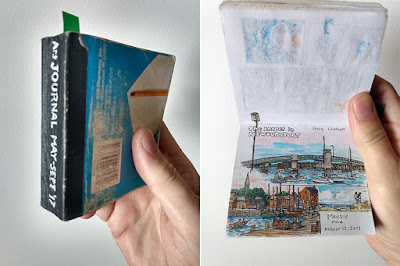
Next, I started making my own pads. I would buy a Caliber, 4" x 6", 200 Sheet, scratch pad pad of unlined, plain-white, decent-quality paper, and would cut it roughly in half, making (4) 4" x 2.75" pads. The paper was thick enough to take watercolors, colored pencil, acrylic, and even some marker, ( if I put a piece of paper underneath to keep it from soaking through).
I would back them with cardboard, and sew the sheets together by hand. I also took some scrap leather, and made what I call the "Frankenpad". A custom-made, brown- leather pad holder. I carried this for years, until it too fell apart.
 |
A half pad, 3.5" x 4", 200 pages
|
I also got tired of the small, and rather cramped drawing space.
I have always had tiny handwriting, and really like drawing and painting tiny things, but I wanted more space, and the hand-made pads were, rather time-consuming to make, so next came the 3.5" x 4", chunky, 200 sheet, Half pad.
 |
A full pad, 4" x 6" 200 pages.
|
 |
More space meant more elaborate art
|
Finally, with the year long Covid-19 pandemic upon us, the need for a pocket-sized pad diminished. No one was going to see me out sketching anywhere anyway, so what was the point? I just went with the full 4" x 6" pad.
Back to the large bound sketchbook
 |
Back to the future with the large 8.5" x 11" format
|
In June of last year I started working on an outline for a graphic novel. I found that the complexity of the frames and the need for readable dialogue, meant that smaller pads no longer cut it, so I changed format again, returning to the original, large, bound-sketchbook once again. Everything eventually comes full-circle I guess.
So...who cares?
Other than my graphic design work, these journals and sketchbooks represent the bulk of whatever my final artistic output will be. I have only ever been an occasional painter, and I lack the discipline and focus to ever have been either a successful illustrator, or a full-time painter. (My attention span is too short). But I have always, always kept a sketchbook. So this is it. My great, or not-so-great legacy. Tiny sketchbook after tiny sketchbook, packed full of tiny drawings, and crazy ideas, and a little bit of who I am, and how I think.
Maybe they'll end up in a landfill somewhere. Maybe they'll be "discovered" long after I am dead, and end up in a museum. Who knows. Probably landfill.